
Can You Really Get Water From the Air? How Atmospheric Water Generators Work
When you start thinking seriously about emergency water, one problem eventually comes up:
Stored water doesn't last forever.
You can store more.
You can identify backup sources.
You can prepare ways to treat water when necessary.
But at some point, you may start wondering whether there are other ways to actually produce more water.
That leads to an interesting question:
Can you really get water from the air?
Yes.
The air around us contains water vapor, even when we can't see or feel it.
An atmospheric water generator, often called an AWG, is designed to collect some of that moisture and turn it into liquid water.
It may sound futuristic, but the basic idea is very real.
The U.S. Environmental Protection Agency has studied atmospheric water generation as a possible source of water during shortages, contamination events, natural disasters, and other times when normal drinking-water service is interrupted.
Researchers continue to study the technology as well. A 2026 review in the Journal of Environmental Management describes atmospheric water harvesting and generation as a growing type of decentralized water supply.
So the question isn't really whether water can be collected from the air.
It can.
The more useful question is:
Could atmospheric water generation make sense as part of your home water plan?
How Does an Atmospheric Water Generator Work?
You do not need to understand complicated engineering to understand the basic idea.
Air contains moisture.
An atmospheric water generator pulls in air and creates conditions that allow some of that moisture to become liquid water.
One common type works through condensation.
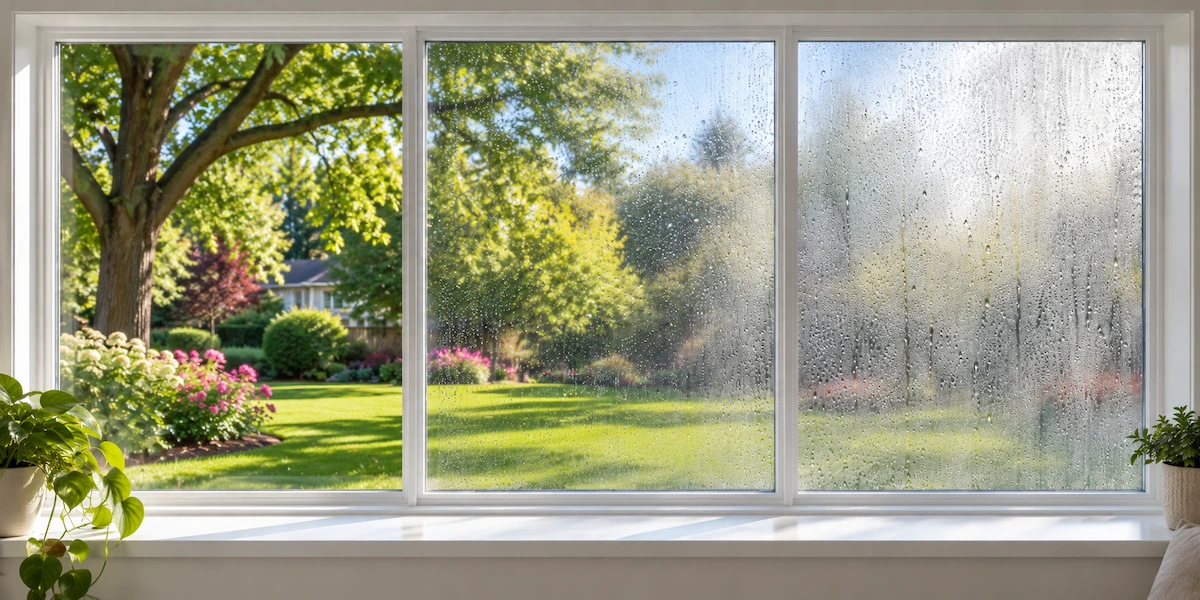
Think about what happens when you take a cold glass outside on a warm, humid day.
Soon, water droplets begin forming on the outside of the glass.
The water did not come through the glass.
It came from moisture that was already in the surrounding air.
A condensation-based atmospheric water generator uses the same basic principle in a controlled system.
EPA says many common AWGs use cooling and condensation to pull moisture from the air.
There are also other ways of harvesting moisture from the atmosphere. Researchers are developing systems that use special moisture-absorbing materials, solar energy, passive cooling, and combinations of several approaches.
For home preparedness, however, you don't need to become an expert on every type.
The main idea is simple:
Moisture in the air can be collected and turned into usable water.
Why This Is Interesting for Emergency Preparedness
Atmospheric water generation becomes especially interesting when you think about replenishment.
Stored water is something you already have.
Every gallon you use makes that stored supply smaller.
An AWG is different because it is designed to keep collecting additional water as long as the conditions and power source allow it to operate.
That does not mean it produces unlimited water.
But it changes the question from:
“How many gallons do I have left?”
to:
“Can I continue adding at least some water to my supply?”
That can be an important difference during a longer interruption.
At ReadyPrepHome, we think about water preparedness in three layers:
STORE → TREAT → REPLENISH
Atmospheric water generation fits into the third layer.
It is not a substitute for the first two.
It is another possible way to help replenish what you use.
Humidity Makes a Difference
There is one important fact to understand about atmospheric water generation:
The amount of water in the air changes.
Warm, humid air normally contains much more moisture than cold, dry air.
That means an AWG that performs well in one place may produce less water somewhere else.
EPA says water production from atmospheric water generators depends heavily on both humidity and air temperature.
Recent research arrives at the same basic conclusion. Climate and operating conditions play a major role in how much water different atmospheric harvesting systems can produce.
This is important because it keeps expectations realistic.
If you live somewhere warm and humid for much of the year, atmospheric water generation may be more attractive.
If you live in a very dry climate, the air simply gives the system less moisture to work with.
That doesn't automatically mean AWG is useless in a dry area. Newer technologies are being developed specifically to work under lower-humidity conditions.
But for a typical household system, your local climate matters.
How Much Water Can an AWG Produce?
There isn't one answer.
The EPA has reported that home atmospheric water generators are capable of producing between 1 and 20 liters per day. Larger commercial systems can produce more.
But that does not mean every home AWG will produce that much every day.
Actual production can change with:
Humidity
Temperature
The type and size of the system
How long it operates
Energy available
System design and maintenance
With so many variables, it can be difficult to estimate the exact output.
Therefore, when evaluating AWG systems, it’s important to remember that claims made about a system’s output are likely estimates based upon ideal conditions.
A better question is:
How much water could this system reasonably produce where I live?
Again, it’s difficult to arrive at an exact amount and it’s best to estimate conservatively. If you live in a more humid climate, an AWG system might produce water in the mid to upper range. In drier environments, the output will be lower.
But here’s the important thing to remember: whatever amount of water your AWG system produces, it’s additional water you can add to your readiness plan – and that’s what makes it valuable.
An AWG Still Needs Energy
There is another practical issue that deserves attention.
Many atmospheric water generators need electricity.
Pulling air through a system to produce water, and sometimes treating the water, requires energy.
The EPA notes that condensation-based systems can require significant energy, although improvements have made atmospheric water generation more efficient over time.
This matters in an emergency.
If the reason your normal water supply is unavailable is also the reason your electricity is out, a grid-powered AWG may not help unless you have another way to power it.
That might mean a generator, battery system, solar setup, or another backup power source.
Again, this doesn't make atmospheric water generation a bad idea.
It simply reminds us that preparedness systems often depend on each other.
A backup water system that requires electricity should be considered together with your backup power plan.
You can also run your AWG system when there is no emergency to buid up your water reserve. You can treat the water to use for drinking, or store it use for other purposes.
Is Water From the Air Automatically Safe to Drink?
No.
This is probably the most important caution to understand.
Water collected from the air should not automatically be assumed safe just because it looks clear.
EPA research has found that microbial growth can occur in atmospheric water systems. Water quality can also be affected by the surrounding air and by what happens inside the collection and storage system.
In plain English:
Making water and making safe drinking water are not exactly the same thing.
A well-designed atmospheric water generator may include filtration, disinfection, or other treatment steps.
But if you build or use a system yourself, you should understand how the water is being treated and whether the finished water has been shown to be safe.
That is why we would personally want proper treatment and water-quality testing before relying on any DIY atmospheric water system as a main source of drinking water.
This is not unique to AWG.
Rainwater, surface water, well water, and many other emergency sources can also require treatment or testing.
The important lesson is simple:
Never judge water safety by appearance alone.
Does AWG Replace Stored Emergency Water?
We wouldn't use it that way.
Stored water has one huge advantage:
It's already there.
If your water goes out tonight, stored water is ready immediately.
An atmospheric water generator has to operate before it produces anything.
Its output may change from day to day.
It may need electricity.
And weather conditions matter.
That's why AWG makes much more sense to us as a replenishment tool than as a replacement for water storage.
Think of it this way:
Stored water gets you through the beginning of the problem.
Treatment lets you consider other available sources.
Replenishment helps extend your options if the problem continues.
An atmospheric water generator can potentially contribute to that third layer.
Could an Atmospheric Water Generator Work for Your Household?
There are a few practical questions worth asking.
Is your climate reasonably favorable?
If your area regularly has warm or humid conditions, AWG may have more moisture available to collect.
If your climate is usually very dry, you should be especially careful about expected output.
Do you have room for the equipment?
Some systems are small enough for home use. Others require more space.
A DIY setup may also need room for related equipment and water storage.
What will power it?
If you're thinking about emergency use, consider what would happen during a power outage.
Would the system stop completely?
Or do you have backup power?
How much water do you actually need it to produce?
An AWG does not necessarily need to supply every gallon your household uses to be useful.
Even adding some water to your supply could help stored water last longer.
That's an important way to think about replenishment.
A system does not have to solve the entire water problem to improve your situation.
How will you handle water treatment?
Know how the water will be filtered, disinfected, stored, and tested.
Don't leave that question until after you've built or purchased the system.
AWG Has Strengths—and Limits
Atmospheric water generation has some appealing features.
It can produce water without needing a lake, river, well, or working municipal water line.
It can continue collecting additional water instead of relying only on a fixed stored supply.
And because moisture exists in the atmosphere almost everywhere, the basic source is widely available.
But there are limits.
Weather affects output.
Many systems need electricity.
They cost money to build or buy.
They require maintenance.
And the finished water still needs to be handled properly.
That is why we don't see atmospheric water generation as a magic answer.
We see it as another option.
And good preparedness is often about having more good options.
Why AWG May Be Worth Considering Even If It Doesn't Supply All Your Water
This is easy to overlook.
Suppose your household normally needs several gallons of emergency water each day.
An atmospheric water generator might not produce every gallon you need.
Does that make it useless?
Not necessarily.
Imagine that you have stored water and are using several gallons each day.
If another system replaces even part of what you use, your stored supply can last longer.
That is the value of replenishment.
You don't always need to completely replace your stored water.
Sometimes you just need to slow down how quickly it disappears.
That is a much more realistic way to think about atmospheric water generation.
Atmospheric Water Generation Is Still Developing
AWG is not a new idea, but the technology continues to improve.
Researchers are studying new materials, better system designs, renewable-energy options, and ways to improve water production in dry climates. Recent 2026 reviews describe active work on condensation, moisture-absorbing materials, solar-powered systems, and hybrid approaches.
That does not mean every new system will be practical or affordable.
But it does mean AWG is more than a preparedness novelty.
It is an active area of water technology with real research behind it.
For homeowners, the challenge is separating the real technology from exaggerated marketing claims.
That's why we think it is worth understanding how the technology works and where its limits are before choosing a system.
Should You Consider a DIY Atmospheric Water Generator?
That depends partly on what you enjoy doing.
Some people want equipment that arrives ready to operate.
Others enjoy building things, understanding how they work, and creating systems they can maintain themselves.
If you're comfortable with DIY projects, building an atmospheric water generation system can be an interesting way to explore this technology while adding another possible replenishment option to your preparedness plan.
But the same practical questions still apply:
How much water might it produce in your climate?
How will you power it?
How will you treat the water?
What will it cost to build?
And does it make sense alongside the water storage and treatment plans you already have?
Those questions matter more than flashy promises.
We Took a Close Look at One DIY AWG Program
Because atmospheric water generation fits so naturally into the replenishment side of water preparedness, we wanted to see what a homeowner-focused DIY program actually provided.
So we purchased Water Freedom System ourselves and went through the materials.
The program teaches you how to build a DIY atmospheric water generation system and includes written instructions, supporting water-preparedness material, a parts-and-tools guide, off-grid information, and a 13-part build video series.
There were several things we liked quite a bit.
There were also a few things we would have preferred to see handled differently—especially stronger independent support for the finished DIY system's drinking-water claims.
If you're interested in exploring atmospheric water generation as part of your own preparedness plan, you can read our full review before deciding whether the program is a good fit.
Water Freedom System Review — What You Get and Is It Worth It?
The goal isn't to replace every other part of your water plan.
It's to answer a more useful question:
Could this give my household one more way to keep water available when stored supplies begin to run low?